
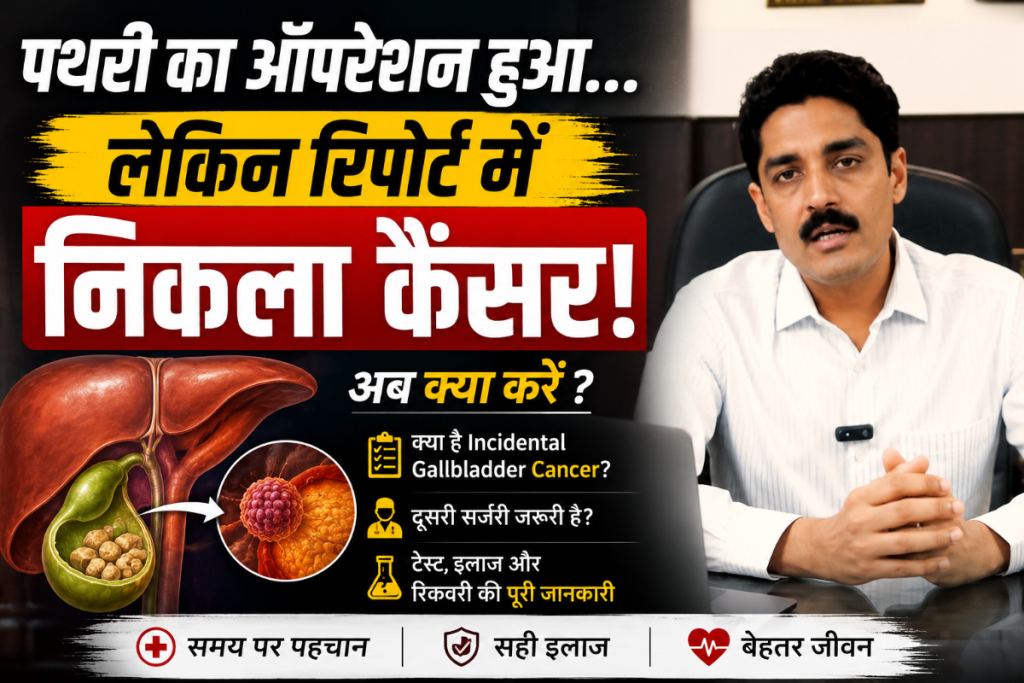
Gallbladder stone surgery is one of the most commonly performed abdominal procedures worldwide. Most patients undergo surgery expecting relief from pain and discomfort caused by gallstones. However, in rare cases, the biopsy report of the removed gallbladder reveals an unexpected finding—gallbladder cancer.
This condition is known as Incidental Gallbladder Cancer (IGBC), meaning the cancer is discovered accidentally during microscopic examination after surgery performed for a seemingly benign gallstone disease.
In this article, we explain what incidental gallbladder cancer is, why it happens, how it is diagnosed, and what treatment options are available.
What is Incidental Gallbladder Cancer?
Incidental Gallbladder Cancer refers to gallbladder cancer that is discovered unexpectedly after a gallbladder has been removed for gallstones or other non-cancerous conditions.
Typically, patients undergo a procedure called Laparoscopic Cholecystectomy, where the gallbladder is removed using minimally invasive techniques. After surgery, the removed gallbladder is sent for pathological examination (biopsy). In approximately 1 out of every 100 patients, the biopsy may reveal cancer cells that were not detected before surgery.
Because the cancer was not suspected beforehand and is found only after surgery, it is called “incidental” gallbladder cancer.
Why Does It Go Undetected Before Surgery?
Many patients wonder whether the cancer should have been diagnosed earlier.
The reality is that incidental gallbladder cancers are often extremely small and hidden. Before surgery, patients usually undergo investigations such as:
- Ultrasound
- Blood tests
- CT Scan (in selected cases)
Although these tests can sometimes reveal suspicious findings like:
- Thickening of the gallbladder wall
- Irregular gallbladder lining
- Abnormal masses
some cancers remain too small to be detected. As a result, the patient experiences symptoms identical to gallstone disease, and the cancer is discovered only when the gallbladder tissue is examined under a microscope.
Why Is Biopsy of Every Removed Gallbladder Important?
One of the most important lessons from incidental gallbladder cancer is that every removed gallbladder should be sent for histopathological examination.
Without biopsy, early-stage cancers can be completely missed.
Pathological examination helps identify:
- Presence of cancer cells
- Depth of tumor invasion
- Involvement of surrounding structures
- Tumor stage
This information becomes crucial for planning further treatment.
What Happens After the Diagnosis?
Receiving a cancer diagnosis unexpectedly can be emotionally overwhelming for patients and families.
However, it is important not to panic.
After reviewing the biopsy report, the treating surgical oncologist performs a detailed assessment, which typically includes:
Review of Previous Medical Records
The doctor carefully examines:
- Pre-operative symptoms
- Ultrasound reports
- CT scan findings
- Surgical notes
- Original pathology report
In some cases, the biopsy slides are reviewed again by expert pathologists to confirm the diagnosis and accurately determine the tumor stage.
Additional Imaging
Patients may require:
- Contrast-enhanced CT Scan
- PET-CT Scan
- Blood investigations
These tests help determine:
- Whether any cancer remains in the liver bed
- Whether lymph nodes are involved
- Whether the disease has spread elsewhere in the body
The treatment plan depends on these findings.
Is a Second Surgery Required?
In many patients, yes.
If the cancer is detected at an early stage and remains localized, a second surgery may be recommended. This procedure is known as Completion Radical Cholecystectomy or Completion Extended Cholecystectomy.
The goal is to remove any microscopic cancer cells that may remain after the first operation.
What Does the Second Surgery Involve?
The surgeon may remove:
Part of the Liver (Gallbladder Bed)
The gallbladder sits attached to the liver. Even after the gallbladder is removed, microscopic cancer cells may remain in the adjacent liver tissue.
Removing a small portion of the liver helps reduce the risk of recurrence.
Regional Lymph Nodes
Lymph nodes act as filtration stations in the body and can harbor microscopic cancer spread.
Removing these lymph nodes helps:
- Achieve complete cancer clearance
- Determine the exact stage of the disease
- Guide future treatment decisions
Is Immediate Emergency Surgery Necessary?
No.
Patients often fear that treatment must be performed within days of diagnosis.
In reality, incidental gallbladder cancer usually allows enough time for:
- Detailed evaluation
- Review of pathology
- Additional imaging
- Surgical planning
A delay of a few weeks for proper assessment generally does not worsen outcomes. Thorough planning is more important than rushing into surgery.
What If the Cancer Has Already Spread?
Unfortunately, some patients are diagnosed when the disease has already advanced.
Signs of advanced disease may include:
- Cancer deposits in the abdomen
- Fluid accumulation (ascites)
- Liver metastases
- Spread to distant organs
In such situations, curative surgery may no longer be possible.
Treatment may involve:
- Chemotherapy
- Targeted therapies
- Supportive care
- Symptom management
The objective then becomes improving quality of life and controlling disease progression.
Can Incidental Gallbladder Cancer Be Cured?
Yes, especially when diagnosed at an early stage.
When the cancer is confined to the gallbladder region and treated appropriately with completion surgery, many patients achieve long-term survival and complete recovery.
Outcomes depend largely on:
- Tumor stage
- Depth of invasion
- Lymph node involvement
- Completeness of surgical treatment
Early-stage cancers generally have excellent outcomes.
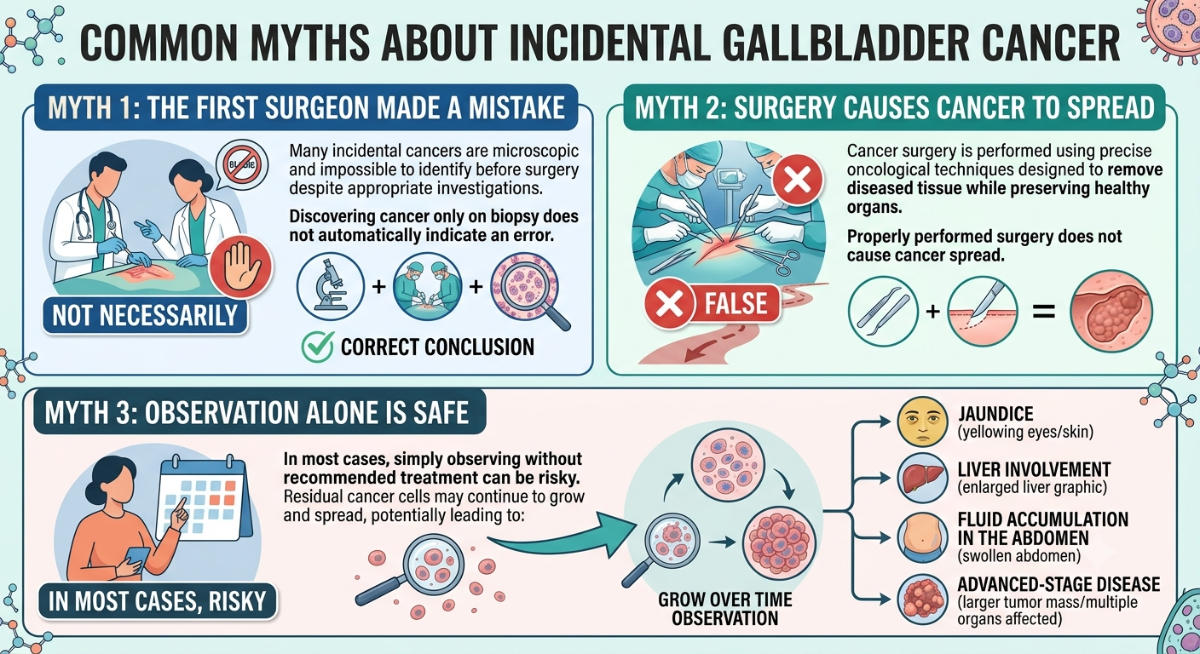
Common Myths About Incidental Gallbladder Cancer
Myth 1: The First Surgeon Made a Mistake
Not necessarily.
Many incidental cancers are microscopic and impossible to identify before surgery despite appropriate investigations. Discovering cancer only on biopsy does not automatically indicate an error.
Myth 2: Surgery Causes Cancer to Spread
This is false.
Cancer surgery is performed using precise oncological techniques designed to remove diseased tissue while preserving healthy organs. Properly performed surgery does not cause cancer spread.
Myth 3: Observation Alone Is Safe
In most cases, simply observing without recommended treatment can be risky.
Residual cancer cells may continue to grow and spread, potentially leading to:
- Jaundice
- Liver involvement
- Fluid accumulation in the abdomen
- Advanced-stage disease
Timely treatment significantly improves outcomes.
Follow-Up After Treatment
After surgery, patients typically:
- Resume a normal diet within days
- Return for wound evaluation within a week
- Review final pathology reports
Some patients may require chemotherapy based on the final stage of the disease.
Long-term follow-up usually includes:
- Clinical examinations
- Blood tests
- Ultrasound scans
- CT scans when necessary
Regular monitoring is often continued for at least five years to detect any recurrence at the earliest stage.
Incidental Gallbladder Cancer Treatment in Kanpur, India
Incidental Gallbladder Cancer is a rare but important condition that highlights the value of routine biopsy after gallbladder stone surgery. While the diagnosis can be unexpected and frightening, early detection offers a significant opportunity for cure.
With timely evaluation, expert surgical management, and appropriate follow-up, many patients can achieve excellent long-term outcomes. If you or a family member has been diagnosed with incidental gallbladder cancer after gallstone surgery, consulting an experienced surgical oncologist is essential for determining the best course of treatment.